One of my greatest pleasures in life lies in preparing and enjoying delicious meals with solid friends. It is, after all, the principle behind Fifty-Two Feasts, this sumptuous project in which I have been indulging for almost a year now. And although I have often eulogized on the joys of dinners, brunches, birthday meals, and festive parties, I rarely reveal my ugly side—my few pet peeves and pent up acidic grievances.
Primary among these objections is the glittering world of food intolerances. It seems almost fashionable today, like chatting about your sun sign in the 70s. I’m a Cancer, what are you? Today, however, a growing portion of the population recites the litany of their own personal “sensitivities” to break the ice with strangers or form heartfelt bonds with friends. “I can’t eat wheat, gluten or dairy,” Angela chirrups cheerfully. “Oh my God, me too!” Jessica responds with delight. An animated conversation follows, one that is as absorbing to its participants as it is tedious to everyone else.
They discuss each minute detail of their mutual affliction, from the description of physical symptoms to sanctimonious recitations of the food they can “handle:” “I’ll have fruit for breakfast,” Jessica admits, as though even this is a sinful indulgence. “Although nothing acidic . . . . And no fruits with too much sugar or starch. So I’ll have like blueberries with like half a teaspoon of agave.” Angela nods attentively, making a mental to research the symptoms of intolerance to acidic/sugary/starchy fruits. Who knows, it is quite possible that she too is unwittingly poisoning her body with venomous oranges!
At some point during this tiresome conversation you will inevitably encounter a stream of advertising for the so-called natural health and wellness industry; the sharing of information on the hoard of vitamins, minerals, oils, and miracle herbals supplements that these sufferer take on a daily basis to banish their multiplicity of ills. These safety measures, in concert with vigilant adherence to dietary commandments, seem to ward off the grim reaper and enable our heroines—or less frequently heroes—to sail ascetically through the day.
Still fascinated with their own digestive systems, Angela and Jessica continue on to exchange recommendations on brands of alternative cookies, breads, and tofu which meet their stringent requirements. (Wait, cookies? I thought . . . okay it’s too complicated for me.)
And all the while they are massacring my carefully constructed, hand rolled ravioli, gouging out the filling and leaving the delicate pasta torn and stranded on the plate. I offer them salad, thinking naively that this is a safe bet, and after cautiously removing the rounds of mozzarella so fresh they barely hold shape and after picking off the warm, herb encrusted croutons, they take a few, insipid bites. Offers of dessert, however, are received with horrified protestations. Coffee? No, the caffeine keeps them awake. Fair enough. I persevere and suggest decaf, trying valiantly to remain cheerful. Alas there is still the problem of acid. It wreaks havoc on their stomachs. Finally, I win with an innocuous herbal tea; victory at last.
In observing the phenomenon of these intolerances, I have noticed some strange and seemingly inexplicable patterns. Firstly, 90% of the time the sufferers are female. Secondly, from time to time these life threatening allergies disappear late at night, perhaps outside a taco truck at 3 am after an evening of bar hopping. Strange.
After years of observing the patterns I’ve come up with many theories on food intolerances: that they are fashions, here today gone tomorrow, a doctor approved alternative or accompaniment to the more base, materialistic obsessions with designer shoes. They are interesting, distinguishing you from the crowd; they make you “unique.” Or perhaps they are the disguised form of an eating disorder—a manifestation of desperate attempts to control and restrict. Then again they may have deeper roots, flowering today as a modern residue of the puritanical rigidity of early American settlers. Whatever the explanation, it is as fascinating to observe the devotees of this new cult as it is frustrating to have them at your dinner party.
And now I want to qualify everything I’ve just said. Firstly, this is a rant, and rage is notorious for skewing the vision and warping the truth. Angela and Jessica are figments of my imagination, monsters dreamed up from a compilation of the worst behaviors I have witnessed, heard, or read about. Secondly, I am aware that some people have totally legitimate allergies to food. In fact a dear friend of mine is relegated to the sofa for days if she upsets her body with the wrong food. But I hazard a guess that she is in the minority as a genuine sufferer. And the difference is that she is far less loquacious about her condition and refers to it in a completely different way. Basically it sucks when you can’t eat 99% of the dishes on a restaurant’s menu. And she’s been like this ever since I’ve known her. Even at 3 am after a night on the town she still can’t eat wheat.
My own theory is that many of the intolerances people experience today are not caused by the food per se but by the toxins in our food system and the methods for processing and preserving that food. Not all milk, cheese, or wheat is created equal! This isn’t just a wacky theory: Read nutritionist Sally Fallon’s book on the subject, Nourishing Traditions or look into the West on Price Foundation. There is a growing body of research to back up this more nuanced, deeper analysis of food intolerances.
Thursday, June 17, 2010


Wednesday, June 16, 2010
Chili, Chocolate, and Cheesecake
The cousins were coming to visit. That is to say the highland dwelling contingent from my dad’s side of the family had landed in the new world for a summer of rambling adventures. They did New York, spent time in Maine, and then—quite sensibly—hopped over that great swath of Jesus land separating the east and west coasts of our great country to arrive in Seattle.
I wanted to welcome them with a truly American meal. And what, I wondered, is a more American custom than appropriating and bastardizing a dish from another culture? So I penned the menu. We would eat chili con carne as the main course followed by an all American fat n’ wobbly cheesecake—two ubiquitous dishes that I’d never attempted to execute.
As a complete amateur, I consulted various recipes for chili and found that within the realm of this craft there is constant warfare. Diced or ground meat? Smoked peppers or not? Should one add cinnamon? Chocolate? Bourbon? Beans or no beans? The debates were endless with belligerent voices on all sides. Clearly, the search for any semblance of authenticity would be long and arduous. I shrugged, gathered together what I considered to be the most exciting recipes, and patched together my own chili: ground beef and finely diced pork, medium heat, a little quirky chorizo, and substantial smoke in the shape of both chipotle and pimentón. And beans, definitely beans for the rather prosaic reason that I wanted to stretch this chili to feed ten people. Finally I tossed in a cinnamon stick and some cacao—fantasizing vaguely about the Aztecs . . . . Or is it the Mayans whole handed us this intoxicating combination?
Equally uninitiated in the process of constructing a cheesecake, I decided not to be overly ambitious and instead to follow a simple recipe for white chocolate hazelnut cheesecake from my favorite dessert book entitled—with self confident simplicity—Chocolate. Unfortunately, I forgot to factor in the time necessary for chilling the cake so that when I plunged a hopeful knife into the center and extricated the first slice, the rest of the cake, in a display of defeat, began melting lugubriously in all directions. Fortunately, the sinfully decadent taste and texture of the dessert made up for its aesthetic failings.
All in all the meal was not only a succulent success, but also ridiculously easy to prepare. In fact to anyone looking for easy menu ideas I can safely say this one is a winner. Chili is a one-pot main course that actually improves slightly if made the day before. Serve it with sour cream, crusty bread and a salad—y ahí lo tiene! And as for the cheesecake, it too is quite literally a piece of cake (tee hee, sorry) to prepare and as I learned, it requires a good chill out in the fridge before serving.

Wednesday, May 19, 2010
Battered and Fried
“You’ve got Maris Pipers.” I beamed at the potato lady, my new hero. “I’ve been looking for these everywhere.”
“Yes,” she responded brightly, “we have them year round.”
I was at the U-district farmers market on a promising Saturday morning. The sun was lazily making its way out of bed, shrugging off a morning mist and gathering strength for the day’s work ahead. The market had just opened its gates and I was there—unusually bright and brisk for the hour—with the farmers, the dedicated locavores, the foodies, and those unfortunates who had been woken at dawn by bouncing bundles of youthful energy. “One day,” I imagined parents saying soothingly to each other, “one day they will become civilized and require a decent amount of caffeine before erupting into wakefulness. Until then, honey, we’ll just have to muster patience and fortitude.” Having already had my caffeine I was in excellent spirits, made even brighter by the discovery of Heston’s lauded Maris Piper potatoes at the Olsen Farm stand.
Deciding that perhaps H. Blumenthal Esq. wasn’t the only expert whose advice was worth noting, I asked the potato lady which variety she would use for frying. “Bintje,” she answered without hesitation, pointing to a pile of spuds that were in shape, texture, and color very similar to Maris Pipers. “They’re starchy enough to fluff up well but they still get nice and crispy on the outside.” So I bought a couple pound for good measure.
There wasn’t much in the way of fish at the market so I opted for Whole Foods. What would the fish guy recommend? Halibut and rock cod. Since the latter was half the price, I bought 1 1/2 pounds of it and a mere 1/2 pound of halibut, just to test the difference. Potatoes, check; fish, check. A couple hours and a particularly exasperating ferry line later I was back in the kitchen.


The process of frying fish and chips is great fun, but I found the most gleeful part of making this meal was the preparation of the batter, a matter I attended to with child-like delight. It involved concocting a mixture of plain flour, rice flour, baking powder, honey, beer, and—surprise surprise—vodka. So boozy, I knew it would be a winner. The beer is added last, and immediately afterward the batter is poured into a whip-it canister and injected with a cartridge of CO2. The canister is then chilled until you are ready to fry the fish, at which point you simply fire the contents into a bowl, coat the fish, and then fry immediately. The batter is wonderfully aerated and once fried it transforms into a delectably light, bubbly, crispy coating for the melting softness of fish.

And the final verdict on the fish? The rock cod won by a landslide over the halibut. The flakes were larger and more ethereal and the chunks cooked through without drying out. Plunge the battered fish into hot oil, let sizzle for a minute, gently turn over and continue frying until golden brown, about another minute or two. The fish may not be totally cooked but the residual heat from its sizzled envelop of batter with finish it off before it reaches the table.


Monday, May 10, 2010
The Second Batch
“I don’t vant any nasty soggy chips. I vant mine crisp und light brown.”
(Captured German soldier, in the BBC’s Dad’s Army)
Having consigned Cook’s Illustrated and it’s mediocre French fry recipe to the trash, I turned again to Blumenthal’s instructions. These called first for the use of Arran Victory or Maris Piper potatoes—two varieties I’ve never heard of and could not find at the local shop. So I compromised and opted for the only high starch spuds available: the ubiquitous Russet Burbank.
The first step to Heston’s chips (See note) was to peel potatoes, cut into ½ - ¾ inch sticks, and rinse under cold running water for a few minutes in order to remove excess starch from theirs surfaces. Next he called for a gentle simmer in salted water until potatoes are just cooked through but not falling apart. Then they are laid on a wire rack and left to chill and dry off in the fridge. When cold, a pan of peanut oil is heated to 250 Fahrenheit and the sticks are simmered until just beginning to color, after which they are removed and chilled again. Finally the oil is heated to 375 degrees and the chips are finished at this high sizzle for about 5 – 10 minutes until crisp and golden brown.
It worked like a dream. A near-paradisaical chip: thin, fiercely crisp exteriors and fluffy, feather-light interiors suggestive of edible cumulus clouds. So now my ambition is increasing and I intend to experiment with a variety of high starch potatoes to find the pinnacle of chipped perfection.
Note: Obviously here I am speaking of “chip” in the English sense and using the words chip and fry interchangeably, although there is a difference. A true fish and chip chip must more substantial, plumper, and generally earthy. No doubt there is a place for the thin, elegant fry but in my opinion these should not be seen nestling up to a pile of battered fish.
Saturday, May 8, 2010
The First Batch
Deciding to save Heston and his pursuit of perfection for tomorrow, I attempted a much simpler method of frying potatoes this evening. It came from a spattered old issue of Cooks Illustrated, and I had made a mental note long ago to give it whirl. The author proposes two unlikely components: low starch, Yukon Gold potatoes and cold oil. I blinked. Of the little I had read about frites, two of the most oft preached principles were the use of high starch potatoes and sizzling hot oil. And yet he seemed tremendously scientific about process, so much so that I put misgivings aside and bustled to the store for a bag of Yukons.
Following his instructions precisely, I washed, scrubbed, and dried the potatoes, squared them off and sliced them into ¼ inch sticks. Dutifully I dropped them into the cold oil, turned on a high flame, and waited for a rolling boil. I let them cook until the outsides were beginning to harden. I stirred them and watched with mounting excitement as they turned from creamy white to pale gold and then to warm caramel brown. Then I whipped the finished fries out of the oil and onto a bed of paper towels.
At first the batons appeared perfectly crisp and burnished brown. Almost hysterical with excitement now I flung a bit of sea salt onto the pile, extracted a particularly alluring specimen, and popped it in my mouth. It was very good indeed. But then I eyed the potatoes with growing panic: here I was with a mound of chips and no one to eat them. I tested another and frowned: were they getting soggy? Already?
Desperate for my imperfect yet decidedly edible fries to be shared, I whipped together a Belgium style dipping sauce in the space of thirty seconds, grabbed the plate of fries, and ran out the door. Sprinting across the road I charged though the neighbor’s yard, across to the next street, and down to my friends’ house.
In the course of my obsession, there are times at which I find myself behaving in an utterly bizarre manner. This was one of those times. The door was open and taking this as an invitation I flew straight into the sitting room. Glenn was on the sofa, one hand tapping at a lap top and the other clasping a phone to his ear. Failing to notice these things I shoved my fries under his nose. “Eat,” I commanded. He looked up, politely bewildered, and reached for a fry. “No!” I hissed. “The little ones, the thin ones are crispier. Quick, eat.” Perceiving that I was borderline delusional, Glenn motioned upstairs. “Molly’s up there.”
I galloped up the stairs, banged on Molly’s door, and let myself unceremoniously in. “Try these.” I thrust the dish determinedly towards her. It would have taken a brave soul with courage—and possibly body armor—to refuse these fries with the cook in such a state of blind hysteria. She smiled diplomatically and ate one, then another. Then we trooped down stairs.
Now that I had shared my fries, sanity returned to my muddled mind, only to be replaced by acute embarrassment. I found myself sitting in Glen and Molly’s sitting room, a plate of fries on my lap, wrapped in my tattered, grease stained polka dot apron, attempting to make ordinary conversation. Only it’s not that easy when you’ve just burst into someone’s house and forced fries on them. Returning to the only topic occupying my consciousness at that moment I looked down at the plate: “They’re soggy,” I commented despondently. “I’ll have to try again.”

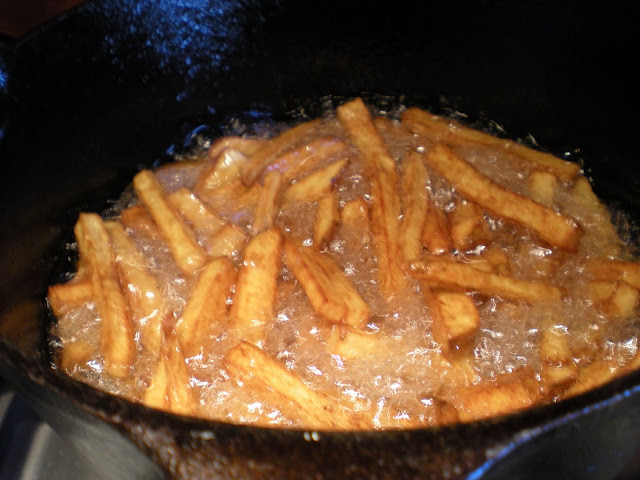

Following his instructions precisely, I washed, scrubbed, and dried the potatoes, squared them off and sliced them into ¼ inch sticks. Dutifully I dropped them into the cold oil, turned on a high flame, and waited for a rolling boil. I let them cook until the outsides were beginning to harden. I stirred them and watched with mounting excitement as they turned from creamy white to pale gold and then to warm caramel brown. Then I whipped the finished fries out of the oil and onto a bed of paper towels.
At first the batons appeared perfectly crisp and burnished brown. Almost hysterical with excitement now I flung a bit of sea salt onto the pile, extracted a particularly alluring specimen, and popped it in my mouth. It was very good indeed. But then I eyed the potatoes with growing panic: here I was with a mound of chips and no one to eat them. I tested another and frowned: were they getting soggy? Already?
Desperate for my imperfect yet decidedly edible fries to be shared, I whipped together a Belgium style dipping sauce in the space of thirty seconds, grabbed the plate of fries, and ran out the door. Sprinting across the road I charged though the neighbor’s yard, across to the next street, and down to my friends’ house.
In the course of my obsession, there are times at which I find myself behaving in an utterly bizarre manner. This was one of those times. The door was open and taking this as an invitation I flew straight into the sitting room. Glenn was on the sofa, one hand tapping at a lap top and the other clasping a phone to his ear. Failing to notice these things I shoved my fries under his nose. “Eat,” I commanded. He looked up, politely bewildered, and reached for a fry. “No!” I hissed. “The little ones, the thin ones are crispier. Quick, eat.” Perceiving that I was borderline delusional, Glenn motioned upstairs. “Molly’s up there.”
I galloped up the stairs, banged on Molly’s door, and let myself unceremoniously in. “Try these.” I thrust the dish determinedly towards her. It would have taken a brave soul with courage—and possibly body armor—to refuse these fries with the cook in such a state of blind hysteria. She smiled diplomatically and ate one, then another. Then we trooped down stairs.
Now that I had shared my fries, sanity returned to my muddled mind, only to be replaced by acute embarrassment. I found myself sitting in Glen and Molly’s sitting room, a plate of fries on my lap, wrapped in my tattered, grease stained polka dot apron, attempting to make ordinary conversation. Only it’s not that easy when you’ve just burst into someone’s house and forced fries on them. Returning to the only topic occupying my consciousness at that moment I looked down at the plate: “They’re soggy,” I commented despondently. “I’ll have to try again.”


Friday, May 7, 2010
Lo Que Corta el Bacalao

As usual with a new idea, it was an odd confluence of happenings that led to the budding of this desire. Firstly, I was given a book that I have long wanted to read: Cod, by Mark Kurlansky. In this beautifully written work, Kulansky follows the journey of this fish as it comes into contact with and later is shaped by human history. It is a fascinating story, surprising in its significance and inspiring in the kitchen. I am still happily swimming in the text, currently drifting by the cod as they unwittingly fuel the fire of 18th century American revolutionaries. But I’m also salivating at the thought of really good battered and fried fish. Secondly, I remain committed to my spring resolution to explore the world of aquatic cookery. On this point, I have been shamefully lazy of late. Furthermore, an old class mate was making fish and chips the other day. “Do you have any tips?” he asked. I had none, having never attempted this wonderful classic, this cornerstone of my culinary heritage. In fact I am woefully ignorant on the subject.
Thankfully ignorance can be remedied, especially now that I’ve got a couple vital tools to aid comprehension: a cast iron fry pot and Heston Blumenthal’s meticulously authoritative cookbook, In search of Perfection, both lent to me by Boss Man, who also generously volunteered to taste test any of my experiments. So, the exploration begins. As the matter of choosing and sourcing the ideal fish is going to be quite a process, I’ve decided in the meantime to start with the chips.
I’ve got a pan, a thermometer, two varieties of potato, and two strikingly dissimilar methods to try. Tonight, let the frying begin! Whatever it takes I am determined to master this meal. The Spanish have an apt idiom for describing who is in charge in a given relationship or situation. It is the one who cuts the salt cod—la que corta el bacalao! That’ll be me, baby.
Friday, April 23, 2010
The Great Cleanse
Justin and I had arranged to go on a ride. “Let’s go on a long one,” I suggested, full of zeal for my new-found love of cycling. But when I showed up at his house, the place was mysteriously wreathed in silence. I called out several time and finally heard a weak voice reply from somewhere in the bowels of the house. Clunking in with my biking cleats, I made my way down the hall. “Come in,” Justin’s voice murmured feebly. I opened the door to find that my friend, rather than clad in one of his usual stream-lined cycling outfits, was curled up in an easy chair, wreathed in blankets and reading a book. “Oh Justin, hurry up. What are you doing?”
He let out a hollow groan of despair and huddled further down into the blankets. “Oh yes, of course!” I exclaimed, recollecting what he had told me earlier. “You’ve started then, have you? You’re really doing it?”
My friends were undertaking the master cleanse. Having thoroughly flushed their digestive systems with salt water, they were now subsisting on a concoction of lemon juice, cayenne pepper, maple syrup, and water. And they planned to complete ten days of this ascetical penance.
At first I was horrified at the mere idea of a ten day fast. Surely, I mused aloud, ten long days living on nothing but this strange concoction must be bad for the body. And what about having the energy to work? I supposed that even the life-saving elixir coffee was banned under this Nazi-like regime. But they were resolute; they were going to cleanse and that was that. And so I shook my head and wondered at the impenetrable motives that would induce anyone to submit themselves to such a clearly masochistic endeavor. I for one would simply raise a glass of Jameson and ginger to their efforts, fanatical as those might be.
My suspicions that this cleanse was in fact deleterious to the body were confirmed when I persuaded Justin out of his cocoon and onto a bicycle. We had not ridden five miles by the time he began grumbling, uncharacteristically bad tempered. Then later, around mile 18, he dropped out entirely and headed home. Just as I though, I said to myself, legs pumping vigorously. Cleanses are fundamentally a bad idea.
That was on day one of their penance, and since our habitual happy hour beers were now off limits, I saw little of Justin and Glenn until day 7, when they came over to my place for a party. By this point neither looked on the point of death as I suspected they would. Rather they both exuded a radiant aura of crystalline purity. Effortlessly forgoing the sangria and tapas, they chatted awhile, sipping on glasses of water, and then virtuously departed. I was thoroughly impressed.
The next morning as I wallowed in a fog of overindulgence, I began to contemplate the idea of a cleanse. Perhaps it wouldn’t be so bad after all. And imagine the sense of success and vitality that I might feel after having achieved such a feat. I might even lose those stubborn five pounds I am always vaguely—although somewhat noncommittally—meaning to drop. I did some research and got mildly excited. The master cleanse claimed to cure all manner of ills, improve hair and skin, revitalize body and mind. Maybe, just maybe . . . .
Well I thought, after visiting my friends one evening, (Glenn was almost finished his penance at day 9 and Molly had survived day 3) if I don’t do it now I might never have the guts to try again. So I rushed to the grocery store and bought a massive bag of lemons. Tomorrow the fast would begin.
Like a dutiful penitent I completed phase one of the cleanse, drinking a liter of salt water on the evening before beginning to fast. (This is a food blog and I have no desire to kill anyone’s appetite so will not explain the rationale behind this salt water flush.) Next morning I awoke with a feeling of grim-faced determination. The prospect did not appeal, but I was going to follow through. Usually I am an early bird, ready to leap out of bed with the sun, but today I already felt unusually irritable. What is the point of leaping out of bed if you have no steaming cup of coffee and crunchy pile of toast to leap into! For a while I lay there cursing into my covers. Then, deciding that a bike ride might raise my spirits, I mustered the courage to sally forth. Once on the road, my mood did indeed improve. Spring was in full force, the sky swirling between sunshine and showers, the heavy scent of growth rich in my nostrils. I must make elderflower cordial soon, I thought, sailing down Swede hill on a honeyed, elderflower breeze.
Towards the end of my ride the shower turned into a determined torrent and I arrived home after 24 miles tired, wet, and ravenous. Worse still I was due at work in an hour and my head was beginning to ache from caffeine deprivation. I stood in the kitchen, shivering and staring fixedly at a jar of Costa Rican coffee beans the color of burnished mahogany. Unscrewing the lid I bend down and inhaled deeply. The aroma ebbed softly into my nostrils, wrapping my mind in a warming blanket of solace. That was enough. My cleanse was over. The beans clattered into the grinder.
The only reminder of my great cleanse was a large bowl of lemons that now dominated my kitchen table. And as they invoked a sense of guilt and failure every time I passed by, I decided that they would have to be dealt with immediately. So after work that evening I came home, retrieved Julia Child from the book shelf, and spent the next hour making her classic tart au citron.
After dinner, as I sat at the table half listening to the conversation, I dug my fork into a slice of ethereal, buttercup yellow tart. And as the sharp tang of lemon bit into my palate, I could have sworn that the acid was washing away all impurities, invigorating my body and rejuvenating my mind.

Julia Child’s Lemon Soufflé Tart
A 10 inch, blind-baked, sugar-crust shell (any basic pâte sablée should work)
3/4 cup granulated sugar
4 eggs, separated
Grated rind of one large lemon
3 tablespoons lemon juice
A pinch of salt
Preheat the oven to 325 degrees F. Beat a half cup of the sugar into the egg yolks until the mixture thickens and pales in color. Beat in the lemon rind and juice. Pour this mixture into a bowl set on top of a sauce pan of barely simmering water. Stir until the mixture has thickened and is just too hot for your finger (165 degrees F). In a separate bowl, beat the egg whites and salt until mixture forms soft peaks. Add the sugar and continue beating until mixture holds stiff peaks. Gently fold egg whites into yolk mixture and pour into the tart shell. Bake for about 30 minutes. Keep an eye on the tart and when it begins to rise and color, sprinkle remaining sugar on top. It is ready when a toothpick or knife comes out clean. Serve hot. (This recipe was taken from Julia Child’s book: Mastering the Art of French Cooking.)
He let out a hollow groan of despair and huddled further down into the blankets. “Oh yes, of course!” I exclaimed, recollecting what he had told me earlier. “You’ve started then, have you? You’re really doing it?”
My friends were undertaking the master cleanse. Having thoroughly flushed their digestive systems with salt water, they were now subsisting on a concoction of lemon juice, cayenne pepper, maple syrup, and water. And they planned to complete ten days of this ascetical penance.
At first I was horrified at the mere idea of a ten day fast. Surely, I mused aloud, ten long days living on nothing but this strange concoction must be bad for the body. And what about having the energy to work? I supposed that even the life-saving elixir coffee was banned under this Nazi-like regime. But they were resolute; they were going to cleanse and that was that. And so I shook my head and wondered at the impenetrable motives that would induce anyone to submit themselves to such a clearly masochistic endeavor. I for one would simply raise a glass of Jameson and ginger to their efforts, fanatical as those might be.
My suspicions that this cleanse was in fact deleterious to the body were confirmed when I persuaded Justin out of his cocoon and onto a bicycle. We had not ridden five miles by the time he began grumbling, uncharacteristically bad tempered. Then later, around mile 18, he dropped out entirely and headed home. Just as I though, I said to myself, legs pumping vigorously. Cleanses are fundamentally a bad idea.
That was on day one of their penance, and since our habitual happy hour beers were now off limits, I saw little of Justin and Glenn until day 7, when they came over to my place for a party. By this point neither looked on the point of death as I suspected they would. Rather they both exuded a radiant aura of crystalline purity. Effortlessly forgoing the sangria and tapas, they chatted awhile, sipping on glasses of water, and then virtuously departed. I was thoroughly impressed.
The next morning as I wallowed in a fog of overindulgence, I began to contemplate the idea of a cleanse. Perhaps it wouldn’t be so bad after all. And imagine the sense of success and vitality that I might feel after having achieved such a feat. I might even lose those stubborn five pounds I am always vaguely—although somewhat noncommittally—meaning to drop. I did some research and got mildly excited. The master cleanse claimed to cure all manner of ills, improve hair and skin, revitalize body and mind. Maybe, just maybe . . . .
Well I thought, after visiting my friends one evening, (Glenn was almost finished his penance at day 9 and Molly had survived day 3) if I don’t do it now I might never have the guts to try again. So I rushed to the grocery store and bought a massive bag of lemons. Tomorrow the fast would begin.
Like a dutiful penitent I completed phase one of the cleanse, drinking a liter of salt water on the evening before beginning to fast. (This is a food blog and I have no desire to kill anyone’s appetite so will not explain the rationale behind this salt water flush.) Next morning I awoke with a feeling of grim-faced determination. The prospect did not appeal, but I was going to follow through. Usually I am an early bird, ready to leap out of bed with the sun, but today I already felt unusually irritable. What is the point of leaping out of bed if you have no steaming cup of coffee and crunchy pile of toast to leap into! For a while I lay there cursing into my covers. Then, deciding that a bike ride might raise my spirits, I mustered the courage to sally forth. Once on the road, my mood did indeed improve. Spring was in full force, the sky swirling between sunshine and showers, the heavy scent of growth rich in my nostrils. I must make elderflower cordial soon, I thought, sailing down Swede hill on a honeyed, elderflower breeze.
Towards the end of my ride the shower turned into a determined torrent and I arrived home after 24 miles tired, wet, and ravenous. Worse still I was due at work in an hour and my head was beginning to ache from caffeine deprivation. I stood in the kitchen, shivering and staring fixedly at a jar of Costa Rican coffee beans the color of burnished mahogany. Unscrewing the lid I bend down and inhaled deeply. The aroma ebbed softly into my nostrils, wrapping my mind in a warming blanket of solace. That was enough. My cleanse was over. The beans clattered into the grinder.
The only reminder of my great cleanse was a large bowl of lemons that now dominated my kitchen table. And as they invoked a sense of guilt and failure every time I passed by, I decided that they would have to be dealt with immediately. So after work that evening I came home, retrieved Julia Child from the book shelf, and spent the next hour making her classic tart au citron.
After dinner, as I sat at the table half listening to the conversation, I dug my fork into a slice of ethereal, buttercup yellow tart. And as the sharp tang of lemon bit into my palate, I could have sworn that the acid was washing away all impurities, invigorating my body and rejuvenating my mind.


Julia Child’s Lemon Soufflé Tart
A 10 inch, blind-baked, sugar-crust shell (any basic pâte sablée should work)
3/4 cup granulated sugar
4 eggs, separated
Grated rind of one large lemon
3 tablespoons lemon juice
A pinch of salt
Preheat the oven to 325 degrees F. Beat a half cup of the sugar into the egg yolks until the mixture thickens and pales in color. Beat in the lemon rind and juice. Pour this mixture into a bowl set on top of a sauce pan of barely simmering water. Stir until the mixture has thickened and is just too hot for your finger (165 degrees F). In a separate bowl, beat the egg whites and salt until mixture forms soft peaks. Add the sugar and continue beating until mixture holds stiff peaks. Gently fold egg whites into yolk mixture and pour into the tart shell. Bake for about 30 minutes. Keep an eye on the tart and when it begins to rise and color, sprinkle remaining sugar on top. It is ready when a toothpick or knife comes out clean. Serve hot. (This recipe was taken from Julia Child’s book: Mastering the Art of French Cooking.)
Subscribe to:
Posts (Atom)